March 27,2026 @04:10 PM
Introduction to SPY ETF vs. ES Futures
The comparison between SPY ETF vs. ES Futures remains one of the most searched and debated topics among active traders. Both instruments provide exposure to the S&P 500 Index, yet they differ materially in structure, tax treatment, trading hours, capital efficiency, and execution mechanics.
The recent shift of active traders from exchange-traded funds toward index futures has often been described as a “Great Migration.” The drivers are practical rather than philosophical. Section 1256 tax treatment in the United States offers blended capital gains rates.
Nearly round-the-clock access allows traders to respond to global macro developments in real time. Margin-based leverage increases capital efficiency for those who understand the risks.
This article provides a structured, fact-based comparison of the SPDR S&P 500 ETF Trust and the E-mini S&P 500 futures contract, focusing on strategy implications rather than marketing narratives.
Instrument Overview
SPDR S&P 500 ETF Trust
SPDR S&P 500 ETF Trust, commonly known as SPY, is an exchange-traded fund that tracks the S&P 500 Index. It was launched in January 1993 and is one of the world’s oldest and largest ETFs.
Key characteristics:
- Structure: Open-ended exchange-traded fund
- Expense ratio: 0.09% annually
- Trades on: New York Stock Exchange
- Trading hours: 9:30 a.m. to 4:00 p.m. Eastern Time, with limited pre-market and after-hours sessions
- Dividend distribution: Quarterly
- Assets under management: Frequently above $400 billion, depending on market conditions.
SPY is fully funded. Investors pay for the full notional value of shares purchased, unless using margin at the brokerage level.
E mini S&P 500 Futures ES
E-mini S&P 500 futures, trading under the ES ticker, are listed on the CME Group. The contract was introduced in 1997 to provide a smaller, electronically traded alternative to the pit-traded S&P 500 futures contract.
Key characteristics:
- Contract size: 50 dollars multiplied by the S&P 500 Index
- Minimum tick size: 0.25 index points
- Tick value: $12.50 per tick
- Trading hours: 23 hours per day, Sunday evening through Friday evening Eastern Time
- Settlement: Cash settled
- Expiration: Quarterly cycle in March, June, September, and December
For example, if the S&P 500 Index is trading at 5000, one ES contract represents $250,000 in notional exposure ($50 multiplied by 5000 (S&P 500 Index). Traders post an initial margin rather than paying the full notional value.
Capital Efficiency and Leverage
One of the primary reasons traders migrate from SPY to ES is capital efficiency.
To replicate roughly $250,000 of exposure using SPY at a price of about $650 per share, a trader would need approximately 385 shares. Fully funding that position would require around $250,000 in capital (385 × $650 ≈ $250,250).
However, U.S. margin accounts are generally permitted to borrow up to 50% of the purchase price under Federal Reserve Regulation T, which could be approximately $125,000. Ongoing maintenance margin requirements, typically around 25% but often higher depending on the futures broker’s policy, must also be met.
While this provides leverage, it remains significantly lower than the capital efficiency of a single E-mini S&P 500 futures contract, which can control similar notional exposure with a fraction of that capital posted as exchange margin.
With ES, the same $250,000 of notional exposure requires only the exchange-mandated initial margin. Initial margin fluctuates with volatility. In recent years, it has ranged between $20,000 to $25,000 per contract, though brokers may require more.
This difference significantly impacts return on capital. Using the same example, a 1% move in the S&P 500 at an index level of 5,000 equals 50 index points. In ES, that translates to 50 points × $50, or $2,500 per contract. With a margin requirement of $24,000, that represents a 10% gain or loss on the posted capital.
In SPY, a 1% move on $250,000 of fully funded exposure is $2,500, but that is only 1% of capital deployed.
Capital efficiency enhances both gains and losses. Traders must distinguish between leverage as a tool and leverage as a risk amplifier. Learn more about Risk Management.
Tax Treatment: Section 1256 Advantage
A central driver of the migration to futures is U.S. tax treatment under Section 1256 of the Internal Revenue Code.
Futures contracts, such as ES, are marked to market at year’s end. Gains and losses are treated as:
- 60% long term capital gains
- 40% short term capital gains
This blended rate applies regardless of holding period.
In contrast, SPY gains are taxed based on holding period:
- Less than one year: Short-term capital gains are taxed at ordinary income rates
- More than one year: Long-term capital gains rates
For active traders who frequently enter and exit positions, the 60-40 blended treatment can result in significantly lower effective tax rates than those on short-term equity gains.
Investors outside the United States must evaluate local tax codes, as treatment varies by jurisdiction.
This material is for informational purposes only and should not be construed as tax advice. Consult a qualified tax professional before making any tax-related decisions.
Trading Hours and Global Macro Sensitivity
SPY trades primarily during regular U.S. equity market hours. Although pre-market and after-hours sessions exist, liquidity is thinner, and spreads are typically wider.
ES trades nearly 24 hours per day, from Sunday evening through Friday evening, with a daily maintenance break. This extended session captures:
- Asian market developments
- European market opens
- Overnight central bank announcements
- Geopolitical events
For example, when macro news breaks at 2:00 a.m. Eastern Time, SPY holders cannot transact in meaningful size. ES futures traders can.
This distinction matters in a world where monetary policy from the Federal Reserve, European Central Bank, or Bank of Japan can move global equity markets outside traditional U.S. trading hours.
Liquidity and Market Depth
Both instruments are highly liquid, but liquidity manifests differently.
SPY is one of the most actively traded securities in the world. Average daily volume often exceeds 60 million shares. Bid-ask spreads during regular hours are typically one cent wide.
ES is among the most liquid futures contracts globally. Daily volume frequently exceeds one million contracts. Depth of market during core U.S. trading hours is consistently robust, supporting efficient execution for both retail and institutional-sized orders.
Execution style differs. SPY trades in a centralized equity order book. ES trades in a centralized futures order book with price-time priority on CME Globex.
For large traders, ES often offers tighter effective spreads when accounting for size, particularly outside regular equity hours.
Dividend and Carry Considerations
SPY distributes dividends quarterly. Investors receive cash distributions that reflect dividends paid by the underlying S&P 500 constituents.
ES futures embed expected dividends into the futures price via the cost-of-carry model. The theoretical futures price equals:
Spot index plus financing cost minus expected dividends over the contract period.
As a result, ES does not pay dividends. Instead, the futures price trades at a premium or discount relative to the cash index, depending on interest rates and dividend expectations.
For short-term traders, this distinction is minor. For longer-term holders, dividend yield and financing cost become meaningful.
Rolling and Expiration
SPY does not expire. Investors can hold indefinitely.
ES contracts expire quarterly. Traders must roll positions forward prior to expiration to maintain exposure. The roll typically occurs during the week preceding the third Friday of the expiration month.
Rolling involves closing the expiring contract and opening the next quarterly contract.
This introduces:
- Spread considerations between contracts
- Execution timing decisions
- Temporary liquidity shifts during roll week
Professional traders monitor volume migration from the front month to the next month to optimize execution.
Strategy Applications
Intraday Trading
For intraday traders, ES offers:
- Greater leverage
- Nearly round-the-clock trading
- Deep liquidity during global sessions
- No pattern day trader rule constraints for U.S. accounts
SPY intraday trading is straightforward but subject to equity settlement rules and pattern day trader minimum equity requirements of $25,000 for margin accounts in the United States.
ES does not impose this specific equity threshold, though brokers may have internal minimum equity thresholds.
Swing Trading
Swing traders who hold positions for several days must evaluate:
- Overnight risk
- Gap exposure
- Margin fluctuations
- Tax implications
ES allows precise exposure with less capital but requires active risk management due to leverage. SPY may suit traders who prefer unlevered or modestly levered exposure without rolling contracts.
Hedging
Institutional and professional traders often prefer ES for hedging portfolios due to:
- Capital efficiency
- Ease of short exposure
- Precision of index beta targeting
Shorting SPY requires borrowing shares and paying potential borrowing costs. Shorting ES requires selling a futures contract with no locate requirement.
Risk Considerations
Leverage is the defining risk characteristic of ES. At an index level of 5,000, a 2% adverse move equals 100 points, or $5,000 per contract. With $12,500 in margin posted, this represents a 40% loss on capital.
Margin requirements can increase during periods of elevated volatility, forcing additional capital deposits.
SPY holders face full notional exposure but without embedded exchange-level leverage. Losses are linear relative to invested capital.
Liquidity events can impact both instruments. During periods of extreme volatility, futures may experience rapid price movements due to lower overnight liquidity. Equity markets can experience halts during regular hours.
Cost Comparison
SPY investors incur:
- Expense ratio of 0.09% annually
- Bid-ask spreads
- Potential brokerage commissions
ES traders incur:
- Exchange and clearing fees
- Brokerage commissions per contract
- No ongoing management fee
For active traders with high turnover, commission structures can favor futures trading, depending on the futures broker’s pricing. For passive investors, SPY’s low expense ratio is competitive.
Regulatory and Structural Differences
SPY is regulated as a security under the Securities and Exchange Commission framework.
ES futures are regulated by the Commodity Futures Trading Commission and cleared through CME Clearing.
Customer protections, margin rules, and account structures differ between securities and futures accounts. Traders must understand segregation of funds, risk disclosures, and futures broker-specific policies.
The Great Migration: Structural Drivers
The shift from ETFs toward futures among active traders reflects structural advantages:
- Section 1256 blended tax treatment
- Extended futures trading hours
- Capital efficiency
- Ease of short exposure
Absence of pattern day trader equity threshold
This migration is most visible among:
- Proprietary trading firms
- Systematic intraday traders
- Macro-focused traders reacting to global news
Long-term investors and retirement account holders often remain in ETFs for their simplicity and familiarity.
Infrastructure and Platform Considerations
As traders transition from ETFs to futures, execution infrastructure becomes more important. Futures markets differ structurally from equities. Margin is exchange-based, contracts must be rolled quarterly, and nearly 24hrs trading requires consistent risk oversight.
Firms such as EdgeClear focus exclusively on futures and derivatives execution, offering commission transparency and clearing access designed for active participants. Futures Broker selection, therefore, becomes a strategic decision rather than a matter of convenience.
Rather than positioning itself as a source of performance, EdgeClear is designed to help traders develop their own edge through reliable infrastructure and informed decision-making.
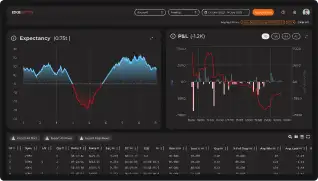
In addition to execution and platform access, EdgeClear Insights is a performance analytics platform that tracks professional trading activity and organizes it into actionable data. Traders can review equity curves, monitor win/loss ratios, and analyze performance trends over time to better understand consistency and behavioral patterns.
EdgeClear Insights functions as a performance review layer within the trading workflow, allowing traders to evaluate how execution and decision-making translate into results. By combining trade logs, real-time performance tracking, and statistical breakdowns, it supports a more data-driven approach to refining strategy rather than relying on subjective interpretation.
This is complemented by access to platforms such as EdgeProX, which offer tools tailored for futures traders, including depth-of-market ladders, advanced bracket order functionality, integrated risk controls, and multi-screen workflow customization. For traders accustomed to equity style ticket entry, these tools represent a shift toward more granular order management and position control.
As capital efficiency increases through futures, the importance of disciplined execution, clear fee structures, and responsive support also increases. The professional trading instrument may change from SPY to ES, but the quality of the infrastructure supporting that decision remains a critical component of long-term consistency.
Conclusion
SPY and ES both provide efficient access to the S&P 500 Index, yet they serve different strategic profiles.
SPY offers simplicity, a cash equity structure, dividend distributions, and suitability for fully funded investors. It aligns well with long-term allocation and retirement accounts.
ES provides capital efficiency, nearly 24-hour liquidity, favorable Section 1256 tax treatment for U.S. traders, and precise hedging capability. These characteristics have driven active traders’ ongoing migration to futures markets.
The decision between SPY and ES is not about which instrument is superior in absolute terms. It is about alignment between structure and strategy. Traders must evaluate capital base, tax jurisdiction, holding period, and risk tolerance.
In a market increasingly shaped by global macro catalysts outside regular equity hours, the structural differences between ETFs and futures are no longer academic. They are central to execution, performance, and the long-term sustainability of professional trading.
Disclaimer: Derivatives trading involves a substantial risk of loss and is not suitable for all investors. Opinions expressed are solely their own opinions and do not reflect the opinions of EdgeClear. Past performance is not necessarily indicative of future results.
Featured Posts
October 1, 2026
Surviving the Sunday Open: Understanding Weekend Gap Risk
September 23, 2026
Long vs. Short. Understanding Investment Strategies
August 26, 2026
Micro-Scaling Futures: Managing Risk in High Volatility
August 24, 2026
E-nano Equity Index Futures: A Smaller Way Into the Benchmarks You Already Watch