
February 03,2026 @07:52 AM
Successful trading is not defined by how often you are right. It is defined by how well you manage risk when you are wrong. Markets are uncertain by nature, and no strategy, setup, or indicator can remove that uncertainty. What separates consistent traders from inconsistent ones is not prediction, but processes and structure. Effective risk management provides the framework that allows an edge to play out over time while protecting both capital and mental capital.
Risk management is often reduced to stop losses and position sizing, but in practice, it is much broader. It encompasses psychology, planning, execution, routine, and accountability. It determines what you trade, when you trade, how much you risk, and when you should step away.
This article explores risk management from multiple angles and explains how these components work together to support long-term trading success.
The Psychology of Risk
Emotions as an Unmanaged Variable
Trading is ultimately a psychological endeavor conducted in an environment with incomplete information. Risk triggers emotional responses, whether it is fear after a loss, overconfidence after a win, or frustration during choppy conditions. If left unmanaged, these emotions can override even the most well-tested strategy.
Redefining What a Successful Trade Means
One of the most important psychological shifts a trader can make is redefining success. A successful trade is not one that makes money, but one that follows the plan. Losses are an unavoidable part of trading. When losses are viewed as failures rather than expected outcomes, they tend to provoke emotional reactions that degrade decision-making.
The Role of a Predefined Risk Plan
This is where a clearly defined risk plan becomes essential. A risk plan removes discretion during moments of stress. It answers key questions in advance, such as which products are traded, which setups are allowed, and how much risk is taken per trade. When these decisions are made outside of market hours, the trader is far less likely to react impulsively in real time.
Understanding Personal Drawdown Tolerance
Understanding personal emotional limits is equally important. Every trader has a threshold beyond which drawdowns begin to affect confidence and execution quality. Ignoring this reality often leads to revenge trading or abandoning a proven process. Effective risk management acknowledges these limits and builds safeguards around them instead of relying on willpower alone.
Quantitative Risk Tools
Defining Risk at the Trade Level
Quantitative risk tools translate abstract concepts into measurable constraints. They provide objective boundaries that protect the account and help stabilize performance over time. At the most basic level, this begins with risk per trade. Some traders choose to risk a consistent amount on each trade, often expressed as a fixed percentage of account value, as part of a broader risk management approach. For example, a trader may choose to risk 2% of their balance on a given trade. This example is provided for educational purposes only and does not account for individual circumstances or risk tolerance.
Session-Based Risk Allocation
Beyond individual trades, session-level risk allocation plays a critical role. One practical approach is to allocate risk based on time-of-day structure. For example, risk can be divided between pre-initial balance and post-initial balance trading. This recognizes that market behavior often changes after the opening range is established and helps preserve capital for higher-quality opportunities later in the session.
Daily Loss Limits and Capital Preservation
Daily loss limits are another cornerstone of quantitative risk management. There are multiple ways to define a daily loss limit, but one effective method is to use the average size of winning days as the benchmark. The logic is straightforward. If a single losing day can be reasonably offset by a typical winning day, the equity curve remains smoother and psychologically manageable. Once the daily loss limit is reached, trading stops for the day, regardless of how compelling the next setup may appear.
Weekly Drawdowns and Size Reduction
Weekly loss limits add a layer of protection. A common approach among experienced traders is to reduce size after reaching a predefined weekly drawdown, often expressed as a percentage of account equity. Cutting the size in half after this threshold allows the trader to stay engaged while reducing emotional pressure and limiting further damage during periods of underperformance.
Technical Risk Controls
Stop Losses as Structural, Not Emotional Tools
Technical risk controls are execution-level mechanisms that enforce the risk plan in real time. These controls are designed to protect traders from momentary lapses in judgment that occur when markets move quickly or emotions run high. Stop losses are the most visible technical control, but they are only effective when used consistently and placed logically. Stops should be defined based on market structure, not on how much pain a trader is willing to tolerate. When stops are widened, removed, or ignored, the entire risk framework begins to erode. Be aware, stop losses are not guaranteed to trigger at specified levels, and actual losses may exceed predetermined stop levels.
Limiting Trade Attempts per Idea
Another important control is limiting the number of attempts per trade idea. Repeatedly re-entering the same idea after multiple failures often leads to overtrading and emotional escalation. By defining in advance how many attempts are allowed, traders preserve both capital and focus.
Broker-Enforced Risk Limits
Broker-side risk controls are among the most effective safeguards available. Setting a broker-enforced daily loss limit ensures that once the threshold is reached, the account is locked from placing additional trades. This removes the possibility of overriding the plan during moments of frustration and protects the trader from themselves.
Platform-Level Safeguards
Platform-level tools that restrict trading after a series of losses or during specific time windows can also be valuable. These controls are not an admission of weakness. They are a recognition that human decision-making deteriorates under stress and that systems should be designed to compensate for that reality.
Market-Specific Risks and Volatility-Aware Allocation
Liquidity, Volatility, and Stop Placement
Risk management must be adapted to the specific markets being traded. Different products exhibit different volatility profiles, liquidity characteristics, and behavioral tendencies, all of which directly influence how risk should be defined and deployed.
A simple comparison highlights this clearly. Gold futures often trade with relatively thinner liquidity on the order book, especially during certain sessions, which can result in wider price swings and less precise execution. As a result, gold typically requires larger stop losses to account for its natural volatility and tendency for abrupt moves. In contrast, products such as ZN or other Treasury futures generally trade with much deeper liquidity and tighter order books. This depth allows for narrower stop losses and more precise risk definition. Position sizing must be adjusted accordingly. As mentioned earlier, stop losses are not guaranteed to trigger at specified levels, and actual losses may exceed predetermined stop levels.
A contract that requires a wider stop should be traded with a smaller size, while products that allow tighter risk can support a larger size within the same overall risk parameters. This relationship between liquidity, stop placement, and size should be explicitly defined in the risk plan. stop losses are not guaranteed to trigger at specified levels, and actual losses may exceed predetermined stop levels.
Matching Setups to the Right Products
Not all setups perform equally well across markets. A setup that works consistently in a highly liquid interest rate product may struggle in a thinner, more volatile commodity market. Limiting trading to a defined set of setups within specific products reduces complexity and increases consistency. This focus also makes performance evaluation more meaningful, as it becomes easier to determine whether results are driven by execution quality or by changing market conditions rather than by product mismatch.
Understanding Product Behavior
Understanding the nature of each product is another essential component of market-specific risk. Some markets trend cleanly, while others rotate frequently. Some respond strongly to macroeconomic data, while others are more technically driven. These behavioral tendencies should factor directly into the risk plan, influencing everything from stop placement and profit expectations to the number of attempts allowed per trade. Trading a product without understanding how it typically moves increases the likelihood of mismanaging risk, even when the setup itself is valid.
Event Risk and When Not to Trade
Event risk adds another important layer. Economic data releases, central bank announcements, and contract roll periods can introduce abnormal volatility, slippage, and sudden shifts in market structure. Risk management is not only about participating during favorable conditions, but also about knowing when conditions are unfavorable. Incorporating clear rules around when not to trade is an often-overlooked but highly effective form of risk control.
Aligning Risk with Expected Volatility
An additional factor in market-specific risk allocation is anticipating changes in volatility. Tier one data releases, such as CPI, Core PCE, and Non-Farm Payrolls, often bring increased participation, expansion in range, and clearer directional movement. These sessions may justify deploying a greater portion of planned risk, provided execution remains disciplined, and the trader is prepared for faster conditions.
In contrast, pre-data release days frequently exhibit compressed ranges and choppier price action as market participants wait for new information. On these days, opportunity may be limited, and forcing trades often leads to low-quality execution. Reducing risk, or even choosing to sit out entirely when nothing sets up cleanly, is a valid and disciplined decision. Effective risk management means reserving capital for environments where volatility and opportunity are expected, rather than expending it during periods of indecision.
Daily Routine and Discipline
Risk management is reinforced through daily routines that support consistency and self-awareness. These routines ensure that the trader shows up prepared and responds appropriately to changing conditions.
Pre-Session Readiness Checks
A pre-session check-in is a simple but powerful habit. Before trading begins, the trader assesses physical and emotional readiness. Factors such as poor sleep, elevated stress, illness, or lingering frustration can impair judgment. On days when readiness is low, reducing size or standing aside altogether can be a form of risk management rather than a missed opportunity.
In-Session Journaling and Awareness
During the trading session, structured processes help maintain discipline. Keeping a physical journal and writing in real time creates intentional pauses. Documenting what the market is doing, what trades are setting up, and how emotions evolve before and after execution helps slow impulsive behavior, reduce tilt, and help keep the trader objective.
Post-Trade Emotional Reset
After each trade, whether a win or a loss, a defined post-trade process reinforces emotional stability. Recording trade details and emotional reactions builds awareness over time. Taking a brief break, such as five minutes away from the screen, allows emotions to settle before the next decision.
Predefined Responses to Emotional Instability
When emotions become unstable, such as anger after multiple stopouts, having a predefined response is critical. This may include locking the trading platform and taking a ten-minute walk around the block. Physical movement helps dissipate stress and prevents reactive decisions. The key is that this response is planned in advance, not improvised under pressure.
How EdgeClear platform helps with Risk Management
Infrastructure as a Discipline Multiplier
Risk management is strongest when supported by proper infrastructure and professional-grade tools. External systems can reinforce discipline and provide safeguards that are difficult to replicate manually.
EdgeClear’s technology stack is built with risk management as a structural priority, not an afterthought. At the brokerage level, EdgeClear enforces hard risk controls such as broker-defined loss limits and auto-liquidation thresholds designed to hopefully prevent catastrophic drawdowns. These controls operate independently of trader discretion, providing a final layer of protection when volatility spikes or discipline breaks down.
At the platform level, tools like EdgeProX give traders granular control over how risk is expressed in real time. Advanced order types, DOM controls, and execution logic allow traders to size positions precisely, manage exposure dynamically, and respond immediately to changing liquidity conditions. Combined with Rithmic’s low-latency market data and order routing, traders see accurate depth through MBO data, fast fills, and minimal execution uncertainty—critical factors when risk decisions are measured in seconds, not minutes.
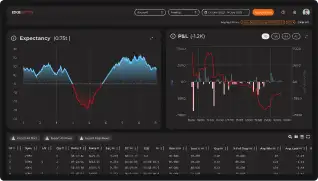
Finally, EdgeWatch closes the risk loop by turning your raw trade data into actionable insight. By analyzing executions, drawdowns, consistency, and behavioral patterns, traders can objectively evaluate whether they are adhering to their risk plans—or slowly deviating from them. Instead of relying on gut feel or hindsight, EdgeWatch provides empirical feedback that reinforces disciplined decision-making and long-term risk alignment.
The purpose of these tools is not to replace personal responsibility, but to strengthen it. When systems, routines, and rules work together, traders are free to focus on execution rather than damage control.
Conclusion
Effective risk management is not a single rule or technique. It is a complete framework that integrates psychology, quantitative limits, technical controls, market awareness, and daily discipline. It determines how much you are willing to lose before losses begin to impair execution, and it establishes systems to prevent crossing that threshold.
Traders who prioritize risk management understand that longevity is the true objective. Profits are the byproduct of protecting capital, preserving confidence, and allowing an edge to play out across many trades and many market cycles. A well-defined risk plan does not limit opportunity. It ensures that one poor session, one emotional lapse, or one unexpected event does not remove you from the market entirely.
Action Step: Write Your Risk Plan
Write out your risk plan in simple, explicit terms. The goal is clarity, not complexity. A strong starting template includes the following elements:
- I clearly define which products I am allowed to trade and which products I will avoid.
- I specify the exact setups I am permitted to trade and commit to ignoring all others.
- I define my fixed risk per trade in dollar terms and do not adjust it impulsively.
- I set a maximum number of attempts allowed per trade idea to prevent overtrading.
- I allocate risk by session structure, such as pre-initial balance versus post-initial balance.
- I define a daily loss limit and stop trading immediately once that limit is reached.
- I define a weekly drawdown threshold at which I reduce size or pause trading to reset.
- I outline how risk will be adjusted on high-volatility days such as major data releases.
- I define rules for low-volatility or pre-data days, including when to reduce risk or stand aside.
- I include broker-side or platform-enforced controls to prevent trading beyond my limits.
- I document my pre-session check-in process to assess physical and emotional readiness.
- I outline my journaling process before, during, and after trades.
- I define a clear response for emotional instability, including stepping away from the platform.
A written risk management plan turns discipline from an intention into a process. When uncertainty increases, and emotions rise, the plan and process become the trade and decision-maker. That is the role of risk management: not to predict outcomes, but to ensure you remain capable of trading tomorrow, next week, and next year.
Disclaimer: Opinions expressed are solely their own opinions and do not reflect the opinions of EdgeClear.The views expressed are personal opinions and should not be interpreted as financial advice.
Featured Posts
February 3, 2026
Effective Risk Management for Successful Trading
January 28, 2026
Giancarlo Saraceno Selected to Ring the Cboe Closing Bell Alongside NIBA
January 28, 2026
Giancarlo Saraceno Joins NIBA to Ring the Cboe Closing Bell
December 23, 2025
EdgeClear’s Giancarlo Saraceno Elected to NIBA Board