
June 09,2026 @02:21 PM
There is a version of market volatility that every investor eventually lives through: the kind where the portfolio you carefully built starts moving in ways you did not plan for. Interest rates rise. Equities sell off. Bond prices fall at the same time. The supposed cushions fail to soften the blow. Consequently, when that happens, the question of how to protect a portfolio without dismantling it becomes a practical, fast one.
Futures hedging is one of the most direct answers to that question. For most of investing history, it was an institutional strategy, reserved for those with the capital, infrastructure, and expertise to run it properly. That has changed.
The introduction of Micro-sized futures contracts, like Micro E-mini futures, near-24-hour trading access, and modern analytics platforms has made futures hedging genuinely accessible to individual investors managing portfolios of almost any size.
This guide explains how the core hedging strategies work, walks through each one with concrete numbers, covers the costs of executing them, and identifies the mistakes that tend to trip up retail traders. All examples use illustrative prices and hypothetical figures designed to show you the mechanics, rather than to reflect any specific market moment.
Why Futures, and Why They Matter for Retail Portfolios
A futures contract is an agreement to buy or sell an underlying asset at a set price on a future date. In the context of hedging, you are not trying to profit from the futures trade itself. You are using it as an offset. If the market falls and your stock portfolio loses value, your short futures position gains. The two positions run in opposite directions, with the futures dampening the damage in your portfolio.
The structural advantage over simply selling your holdings is significant. You can keep your long-term positions, continue receiving dividends, and avoid triggering capital gains events. You hedge around your portfolio rather than liquidating it. This is especially valuable when a selloff looks temporary, and you do not want to miss the recovery.
Goldman Sachs Asset Management has documented what many investors felt firsthand in recent cycles: the stock-bond correlation has swung back into positive territory in periods of elevated inflation risk, eroding the protective value of the traditional 60/40 portfolio. When equities and bonds fall together, the conventional diversification logic breaks down.
Futures provide a direct, scalable offset that does not depend on an asset correlation holding up under stress. Effective Risk Management strategies often rely on these decoupled instruments to provide protection when traditional bonds fail to serve as a safety net.
On the access side, the CME Group’s suite of Micro futures contracts, including the Micro E-mini S&P 500 (MES), the Micro E-mini Nasdaq-100 (MNQ), Micro Gold (MGC), and Micro Treasury Yield futures, has made it possible for retail investors to trade the same instruments as institutional desks at a fraction of the notional size and margin commitment.
These contracts trade 23 hours a day, five days a week, which matters when risk events happen outside regular market hours.
Hedging Costs: Capital Requirements
Before looking at individual strategies, it is worth understanding exactly what you are committing to when you place a futures hedge. Margin in futures is not a down payment in the traditional sense. Your broker holds a good-faith deposit to cover potential daily losses.
The position is marked to market at the end of each session, and gains or losses are credited or debited to your account in real time. These capital requirements are fundamental to professional Risk Management strategies.
To illustrate the capital requirement, assume the Micro E-mini S&P 500 (MES) is trading at a hypothetical index level of 5,500. Each MES contract controls a notional value of 5,500, multiplied by the $5 multiplier, for a total of $27,500.
The CME overnight maintenance margin for MES has typically ranged from $1,200 to $1,600 per contract, with the initial margin slightly higher. Always verify current figures directly with EdgeClear or on the CME website before placing any trade, as margin requirements change with market conditions.
Required Hedging Capital
The table below outlines approximate capital requirements for hedging various portfolio sizes. These figures assume a portfolio beta of roughly 1.1 and include a 30% cash reserve to absorb adverse mark-to-market movements.
Note: We explain Beta later in this article.
The reserve is not optional. It is what keeps you from being forced out of a hedge during a brief market rally before a larger decline resumes.
| Portfolio Size | Approx. MES Contracts | Est. Initial Margin | 30% Reserve Buffer | Total Cash Needed |
| $50,000 | ~2 contracts | ~$3,000 | ~$900 | ~$3,900 |
| $100,000 | ~3–4 contracts | ~$5,500 | ~$1,650 | ~$7,150 |
| $200,000 | ~6–7 contracts | ~$10,000 | ~$3,000 | ~$13,000 |
| $500,000 | ~15 contracts | ~$24,000 | ~$7,200 | ~$31,200 |
Note: figures are illustrative. Verify live margin with us or CME before trading.
The key practical takeaway: to run a responsible hedge on a $100,000 stock portfolio, expect to have $7,000 to $8,000 in your futures account. That is not the cost of the hedge itself. It is the total capital commitment needed to run the position with a sufficient buffer to avoid a forced exit at the wrong time.
Technical Risk Management: Five Data-Driven Hedging Protocols
To streamline your technical workflow, we have consolidated the five core strategies from this guide into a single downloadable file. This resource is a comprehensive guide to implementing beta-weighted hedging, interest-rate offsets, and non-correlated buffers in your trading ecosystem.
By keeping these data-driven frameworks accessible, you can refine your methodology and apply precise mathematical offsets when market volatility requires a structured, analytical response. These proven Risk Management strategies let you stay defensive without sacrificing long-term goals.
Professional Hedging Frameworks: Managing Risk with Precision
Navigating market volatility requires more than just diversification; it demands a proactive strategy to defend your capital. Below is a summary of the data-driven hedging strategies detailed in this guide, designed to help you maintain a resilient portfolio.
NOTE: Risk management strategies may not prevent clients from experiencing losses
Risk Management Strategies Frameworks
- The Short Futures Hedge: This foundational approach involves shorting a futures contract that tracks your equity holdings to offset potential losses. For broad U.S. exposure, the Micro E-mini S&P 500 (MES) is standard, while the Micro E-mini Nasdaq-100 (MNQ) is utilized for portfolios weighted toward growth and technology. Integrating these Risk Management strategies for the Micro Futures ensures that broad market declines do not devastate your primary equity holdings.
- Tactical Calendar Spreads: To avoid gaps in protection when futures contracts expire, traders use calendar spreads to “roll” a position into the next quarter. This technique can also be applied tactically to hedge specific, short-term event risks—such as earnings seasons or central bank meetings—without liquidating long-term holdings.
- Interest Rate Defense: Rising rates pose a direct threat to bond funds and interest-rate-sensitive equities. Shorting the 10-Year Treasury Note futures (ZN) or the Micro 10-Year Yield futures (10Y) allows investors to hedge duration risk and absorb losses from shifting yields.
- Advanced Cross-Hedging: For concentrated portfolios, broad index hedges may create “basis risk” when the hedge doesn’t align with the portfolio’s losses. This strategy involves selecting a futures instrument—like Micro WTI (MCL) for energy-heavy portfolios—that more closely mirrors the specific sector risk being managed.
- Non-Correlated Buffers: Gold historically acts as a safe-haven asset during “risk-off” events. Incorporating long Micro Gold (MGC) futures provides a layer of protection that does not create a “drag” on performance during equity rallies, but activates during geopolitical or credit disruptions.
Risk Management Strategies Guide
The strategies above are only the beginning. To access the full mathematical formulas, capital commitment calculations, and detailed step-by-step worked examples for each hedge, download the full instructional PDF.
Common Hedging Mistakes to Avoid
Waiting for the market to move first.
The most frequent error is establishing a hedge after a decline is already underway. By that point, futures prices have moved, implied volatility has risen, and protection is more expensive and less precise.
A hedge established during calm, low-volatility periods costs less and provides a cleaner offset. The time to buy insurance is before the storm, not during it. Proactive Risk Management strategies prioritize monitoring, timing, and volatility.
Over-hedging.
Shorting more contracts than your beta weighting calls for creates a net short position. If the market recovers, you lose on the futures at a rate that exceeds what your stocks gain. The formula is not optional. Skipping it is how over-hedges happen, and they are painful in a rising market.
Choosing the wrong instrument.
A broad S&P 500 hedge on a concentrated technology or sector portfolio leaves most of the specific risk unhedged. In a sector-driven selloff, the index may decline modestly while your portfolio drops sharply. Always match the futures instrument to the actual composition of what you own.
Cutting the hedge too early.
When a market rally makes a short position uncomfortable, the impulse is to close it. Many retail traders do exactly this, often just before the market resumes its decline. The hedge disappears precisely when it was about to prove its value. This pattern shows up consistently in trading journal data, which is one of the most compelling arguments for disciplined record-keeping.
Underestimating margin dynamics.
A market rally while you hold a short hedge means your futures account is debited in real time, even as your stock portfolio gains on paper. The two do not offset each other from a cash flow standpoint. Without a reserve buffer, you get margin-called out of the hedge at the worst possible time. The 30% reserve is not a suggestion.
Ignoring the total cost of carry.
Bid-ask spreads, quarterly roll costs, and opportunity costs in a rising market all compound over time. Track total hedge cost in your journal. A hedge that costs 1.5% per year to maintain makes sense if it prevents a 15% drawdown every few years. Whether it does require honest measurement.
Position Sizing and Margin Discipline
Sizing correctly and managing margin are where most retail traders succeed or fail in practice, independent of which strategy they choose. Professional risk managers typically limit risk to 1–2% of total futures capital per hedge adjustment. On a $10,000 futures account, this means a maximum expected loss of $100 to $200 before reassessing the position.
Futures positions are marked to market daily. If a position moves against you, funds are debited from your account in real time. Falling below the maintenance margin triggers a margin call, requiring immediate deposits or position liquidation.
With a short hedge, a brief market rally creates cash pressure on your futures account even as your stock portfolio gains on paper. This is expected behavior, not a sign the strategy is failing. The reserve buffer is what keeps you from reacting emotionally to it. These behaviors are essential pillars of sustainable Risk Management strategies.
A practical rule is to keep around 30% to 50% of your futures account capital in reserve. A forced liquidation during a brief countertrend move, when you are correct about the direction but temporarily wrong about the timing, is one of the costliest outcomes in futures hedging.
Define your exit conditions before you place the hedge. If your original thesis fails, exit and reassess rather than holding indefinitely. Know in advance how much of an adverse move you are prepared to absorb before stepping back to reconsider.
Tracking Your Hedges: Why Journaling Is Part of the Strategy
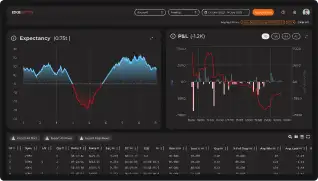
EdgeClear Insights automates the journaling process for futures traders. It integrates directly with the Rithmic data feed, automatically pulling your trade data without manual imports. The platform calculates expectancy, total P&L, win‑to‑loss ratio, average gains and losses, and the time spent in winning versus losing trades, all presented in a clear visual format and provided free to all EdgeClear clients.
For hedgers in particular, the time‑in‑trade metric is often the most uncomfortable and the most valuable. The single most damaging behavioral mistake in hedging is closing a short position during a market rally because it becomes difficult to hold, only to see the market resume its decline days later.
EdgeClear Insights highlights this exact pattern in your own trade history, replacing intuition with actual data. Over time, that record becomes one of the most effective tools for understanding where returns are being given back.
EdgeClear’s weekly market commentary and chart analysis, published through its research channel in collaboration with TradingView, provides the macro and technical context hedgers need to decide when to initiate, extend, or remove protection.
EdgeShorts, the platform’s short educational video series, covers core mechanics such as margin management, order‑flow reading, and hedge sizing in concise formats designed for traders who learn best through practical examples. Consistent education is vital for refining your Risk Management strategies.
Putting It All Together
The five strategies in this guide are not mutually exclusive. A well-constructed retail hedging framework might combine a partial MES short for broad equity protection, an MNQ short for a tech-heavy portion of the portfolio, a ZN short to manage rate sensitivity in a fixed income allocation, and a modest long MGC position as a non-correlated buffer.
None of these requires large capital commitments when sized using the formulas in the PDF, and together they create a layered risk management posture that professionals have used for decades. Adopting multi-layered Risk Management strategies can provide the necessary resilience for any market condition.
The mechanics of each strategy can be learned in a weekend. What takes longer, and what truly separates effective hedgers from those who give back their gains, is execution discipline. It means sizing every position using the formula, maintaining the reserve, tracking every trade honestly, and refusing to let temporary discomfort override a well‑reasoned plan.
The examples in this article are starting points. Run the calculations for your own portfolio, your own beta, and your own futures account before placing any live trade.
Markets will always move in ways that surprise people. Having a plan for when they move against you is not pessimism. It is the most rational thing a long-term investor can do.
Disclaimer: This article is for informational and educational purposes only and does not constitute financial or investment advice. Derivatives trading involves a substantial risk of loss and is not suitable for all investors. Opinions expressed are solely their own opinions and do not reflect the opinions of EdgeClear. All prices and margin figures used in examples are illustrative and hypothetical. Margin requirements and contract specifications change frequently, so always verify current figures directly with EdgeClear or the CME Group before placing any trade. Past performance is not indicative of future results. Consult a licensed financial professional before making any trading decisions. Contract specifications change frequently, so always verify current figures directly with EdgeClear or the CME Group before placing any trade. Past performance is not indicative of future results. Consult a licensed financial professional before making any trading decisions.
Featured Posts
October 1, 2026
Surviving the Sunday Open: Understanding Weekend Gap Risk
September 23, 2026
Long vs. Short. Understanding Investment Strategies
August 26, 2026
Micro-Scaling Futures: Managing Risk in High Volatility
August 24, 2026
E-nano Equity Index Futures: A Smaller Way Into the Benchmarks You Already Watch