
March 18,2026 @04:07 PM
In Part 1, we broke down the structural DNA of equity index futures, establishing that Micros and E-minis contracts track the same markets but offer different notional exposure scales. We saw how the 10:1 ratio between these contracts provides the foundation for more granular control over your market view.
Now, we move from structure to application. While the underlying index moves the same way for both, the impact those moves have on your account, and the costs associated with capturing them, vary significantly.
Contract Size, Notional Exposure, and Price Sensitivity
The primary distinction between micro and mini contracts lies in the notional exposure each represents. To determine notional value, multiply the index level by the contract’s multiplier. This calculation shows that E-mini futures offer significantly greater exposure per contract than their micro counterparts.
Although both micro and E-mini contracts share the same minimum price increment of 0.25 index points, the monetary value of each price movement differs based on contract size. For example, a one-point move in the S&P 500 corresponds to a $50 change in an E-mini contract and a $5 change in a micro contract.
This proportional scaling means that micro contracts track identical index movements while producing smaller incremental profit and loss changes per contract. As a result, contract size directly influences how market participants adjust exposure, structure positions, and experience volatility within equity index futures markets.
Liquidity Characteristics
Liquidity refers to the ability to execute trades without materially impacting price. E-mini contracts generally exhibit deeper order books and higher average volume per price level. This depth can contribute to tighter bid-ask spreads, particularly during high-volume professional trading periods.
Micro contracts have also developed substantial liquidity since their introduction, but depth at each price level is generally lower than in E-mini contracts. Under certain market conditions, such as periods of reduced participation or heightened volatility, this depth difference may lead to wider spreads or increased slippage.
Execution quality in both contract types can vary by time of day, session overlap, and overall market activity, particularly around major economic releases or volatility events.
Transaction Costs and Execution Considerations
Three main components comprise transaction costs in futures trading: commissions, exchange and clearing fees, and execution-related costs like bid-ask spread and slippage.
Because micro contracts represent a smaller notional value, market participants often use multiple micro contracts to approximate the exposure of a single E-mini contract. In these cases, traders incur commissions and per-contract exchange fees on every micro contract traded. This often results in higher cumulative costs for the same notional exposure compared to a single E-mini contract.
E-mini contracts consolidate exposure into a single order with a single set of fees, unlike multiple smaller micro-contract transactions. E-mini contracts can reduce commission costs, though execution occurs at one price and remains sensitive to timing and market. Order book depth differences between micro and mini contracts impact how spreads and slippage contribute to total execution costs.
As a result, transaction cost considerations are commonly evaluated in relation to professional trading frequency, typical order size, and the scaling or adjustment of exposure, rather than contract size alone.
Position Scaling and Exposure Adjustment
One commonly cited characteristic of micro contracts is the ability to adjust exposure in smaller increments. Because each micro contract represents a fraction of an E-mini, exposure can be increased or reduced more gradually.
This incremental approach to position sizing can be relevant in strategies that involve scaling into or out of positions, adjusting exposure during volatile conditions, or managing portfolio-level risk.
E-mini contracts, by contrast, offer fewer sizing increments, which may result in larger changes in exposure when positions are adjusted.
E-mini contracts utilize larger notional increments, causing more pronounced exposure changes for deployed capital compared to smaller, granular micro contracts.
Educational and Observational Applications
Micro contracts are frequently referenced in educational contexts to observe the behavior of equity index futures under live market conditions. Micro contracts mirror E-mini price discovery during overnight sessions and macro volatility because they track identical indexes on shared exchanges.
Participants observe price discovery, liquidity, and volatility shifts across sessions at a smaller notional scale per micro contract.
Strategy Development and Testing
Traders frequently use micro contracts to develop and evaluate strategies in live markets. The smaller contract size allows them to execute real orders with real-time feedback—including interactions with bid-ask spreads and varying liquidity—while limiting the notional exposure of each position.
In this context, micro contracts function as a structural tool within the same market as E-minis. They allow traders to evaluate strategies using the same venue, execution mechanics, and price discovery process rather than a separate or simplified environment.
Risk Characteristics of Futures Contracts
Regardless of contract size, futures trading involves leverage and the potential for losses that exceed the initial margin deposit. Both contracts carry full directional exposure; rapid adverse movements can occur during economic releases or periods of high volatility.
The smaller notional size of micro contracts does not eliminate risk; it alters the scale at which gains and losses are realized.
For example, a 10-point adverse move in the S&P 500 results in a $500 loss per E-mini contract and a $50 loss per micro contract. While the dollar impact differs, the percentage move in the underlying index and therefore the directional risk is identical.
Consequently, improper position sizing, over-leveraging, or failing to manage downside risk still leads to significant drawdowns when trading micros. These risks intensify when traders use multiple contracts to replicate larger exposure. Learn more about Risk Management.
Selecting Contract Size as a Structural Decision
Selecting between micro and E-mini contracts determines exposure granularity, not trade direction or the specific strategy employed. Contract size dictates notional exposure, margin use, transaction costs, execution quality, and the ability to scale positions incrementally.
Micro contracts allow finer exposure adjustments, perfect for partial scaling and risk-constrained strategies during high volatility, where precision matters.
E-mini contracts provide deeper liquidity and tighter spreads for larger sizes, though they offer fewer contract-size increments. Rather than serving as direct substitutes, micros and minis function as complementary instruments within the same market structure. Traders select contract sizes based on account scale, volatility, liquidity, and execution priorities at any given time.
Platform Tools and Contract Size Implementation
Contract size represents only one part of exposure management in futures trading. Platform-level tools also influence how traders monitor, adjust, and execute positions. Particularly, when scaling between micro and E-mini contracts.
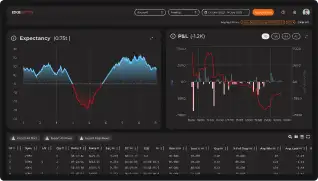
EdgeClear supports this process through execution workflow, analytics, and professional market connectivity. EdgeClear Insights (formerly EdgeWatch) provides visibility into account-level performance metrics, execution detail, and trade outcomes, allowing traders to review how contract size and scaling decisions translate into realized results over time.
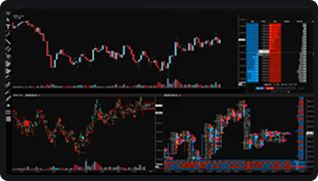
EdgeProX supports a structured order-entry and trade-management workflow, helping traders manage exposure consistently, whether a position is expressed in one E-mini contract or multiple micro contracts. The platform also supports cross-contract functionality, allowing users to chart the E-mini while executing orders in the corresponding Micro contract. This can provide flexibility in how market data is viewed and how exposure is implemented across contract sizes.
Data and routing quality can also affect execution conditions. EdgeClear offers access to low-latency solutions, including Rithmic, CTS, and CQG, for market data and order routing, supporting real-time pricing and order handling across major futures markets.
Conclusion
In practice, choosing between micros and E-minis is less about preference and more about precision. The contract you trade becomes the unit through which risk is expressed. When that unit is too large, even a correct market read can become an unacceptable drawdown.
Structurally aligned, E-mini and micro futures trading differ primarily in contract size and notional exposure. Flexible exposure demand drives growth.
Micro contracts offer smaller notional exposure, enabling granular sizing, reduced profit-and-loss variability, and accessibility across diverse account sizes. At the same time, their smaller scale introduces trade-offs. Using multiple micro contracts increases cumulative commissions and exchange fees. Certain market conditions also expose traders to different liquidity and slippage characteristics.
E-mini contracts offer deeper liquidity and lower per-unit costs, but feature larger minimum exposure increments and pronounced profit/loss changes. These characteristics influence how exposure is adjusted, how execution is managed, and how volatility is experienced.
Understanding structural differences in exposure, liquidity, and execution is a core component of equity index futures trading education. Rather than serving as substitutes, micro and E-mini contracts function as complementary instruments within the same market framework. Their coexistence expands the ways traders structure and manage equity index exposure as markets evolve.
Key takeaway:
Micros and E-minis are not substitutes but complementary tools. Micros emphasize sizing precision and accessibility, while E-minis emphasize liquidity and execution efficiency. The appropriate choice depends less on market structure and more on the trader’s ability to control exposure relative to volatility.
Featured Posts
October 1, 2026
Surviving the Sunday Open: Understanding Weekend Gap Risk
September 23, 2026
Long vs. Short. Understanding Investment Strategies
August 26, 2026
Micro-Scaling Futures: Managing Risk in High Volatility
August 24, 2026
E-nano Equity Index Futures: A Smaller Way Into the Benchmarks You Already Watch